
Apple’s AirPods were first released in 2016 and was met with unreceptive and hostile reviews by consumers, especially since it was launched alongside the iPhone 7, which itself was a topic of much controversy due to it’s absence of a headphone jack.
However, fast forward to 3 years later and AirPods have become Apple’s second best-selling product of all time, while also launching an improved version in the AirPods Pro.
On that account, how on Earth did Apple manage this spectacular turnaround of events? Let’s take a look at a few factors that contributed to the success of its virality.

Firstly, we live in a world where we have too many choices & too little time, hence, most of the time we find that things don’t grab our attention unless they’re truly remarkable. Perhaps in this case, the AirPods were more ‘remark’-able. Thousands of memes about the product were released online mocking its ridiculous design. However, this actually worked in Apple’s favour as AirPods became a trending topic on social media worldwide, which only helped to spread awareness. In this situation, there really wasn’t such a thing as bad publicity.
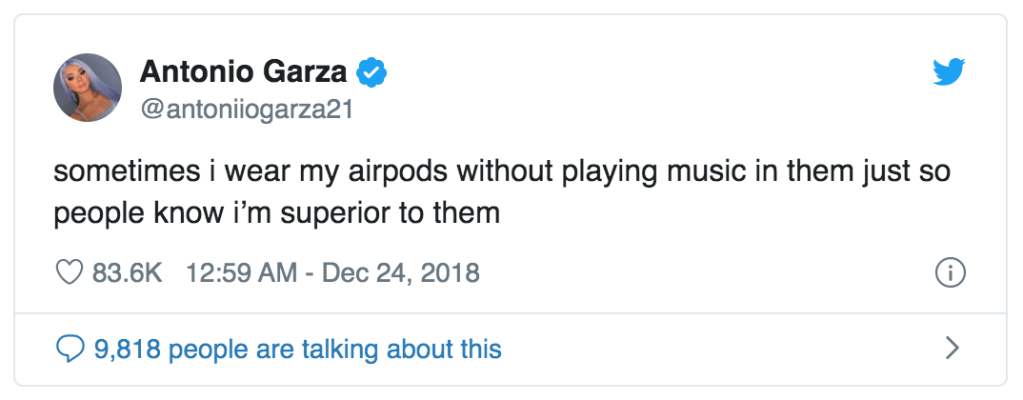
Next, there is social currency attached to the AirPods in that it provides its owners identity Wearing AirPods has become a signal to others of your social status: Others know that their owners have an iPhone but can still afford an SGD239 pair of wireless headphones despite having a wired pair that comes with the iPhone.

Lastly, Apple made their design work for them. AirPods were designed to be highly visible with its striking white colour and the base of the earbuds sticking out from under the users ear. Ironically, Apple’s designers were almost trying to show others that AirPods lack wires. This is what sparked curiosity and made the product so intriguing.
To wrap things up, Apple created a product that was out of the ordinary in order to stand out and spark conversations that could potentially make it viral. However, this decision also involved plenty of risk, which is also one of the factors in going viral. As Seth Godin mentioned, the riskiest thing to do when trying to spread ideas is being safe.
But of course, I want to know what you guys think. Are there really a set of rules to follow to go viral? Or does it merely occur by chance? Let me know in the comments!
 Digital Marketing with Glenn
Hi Glenn, I personally feel that there is a certain set of rules to follow in order to go viral. The content has to be of INTEREST to the audience for them to start sharing or spreading to their friends or family members. Also, the TIMING is very important. These are what I feel, is important for virility. Anyway, thanks for sharing such wonderful insights! Looking forward to your next post (:
LikeLike
Thank you for reading Elton! Indeed, if your content isn’t appealing to others, they won’t have a reason to share it with others.
LikeLike
C’est magnifique! Bonne idée! Nowadays people are bombarded with tons of information. What differentiates you from the rest of marketing firms would be how interesting/attention capturing your stuff is. I feel for something to be viral, it has to be amusing, yet convey your message across. Bonne chance!
LikeLike
Merci Yee Hao! Differentiation is indeed the backbone of many viral campaigns, and having an amusing factor to it helps for sure!
LikeLike
Hi Glenn,
In my opinion, there isn’t a set of rules to follow in order to go viral but rather the right time/place to do it. Apple did it at the same time when they release their iphone without the earphone jack. This creates a minor “inconvenience” as you have to first attach a lightning jack before attaching the earphones and you could also easily misplace the lightning jack. With that, people would be more swayed towards purchasing a pair of airpods. I agree with the point that it provides a social currency to the user wearing it. Apple really knows how to make their users feel better about themselves.
LikeLike
Hey HJ, indeed Apple is really one of the best when it comes to understanding their consumers, but it definitely helps that a lot of them are extremely loyal to the brand. Interesting point you’ve highlighted about the role that timing plays, whereby Apple gave a reason for their users to switch to a wireless option.
LikeLike
Hello mister Glenn,
There is definitely a strategy towards going viral as demonstrated by online searches but I feel like a lot of it also boils down to luck, someone famous helping the campaign spread and be the ‘virus carrier’ like a super spreader, just like COV-19, which I am disappointed you did not reference to.
So in the end, in my opinion it’s both luck and strategy.
LikeLike
Insightful opinions you’ve provided chyi han! I definitely have to say that sometimes luck has a part to play, a lot of the things that go viral weren’t even intended to go viral in the first place.
LikeLike
Hey Glenn, i do not think that there is a set of rules to follow in order to go viral. However i think that the strategy and how out of place/remarkable the product is that plays a large part in going viral. We have so many similar products that has basically the same functions around us that we get desensitised to it but when something out of the ordinary catches our eyes and we start commenting and sharing about it, there is a possibility of it going viral. It was a great read overall and i’ve learnt a lot from your perspective!
LikeLike
Thanks for reading Ian! 100% agreed that there really isn’t a particular set of rules to follow, but being different & remarkable will contribute to the possibility of something going viral.
LikeLike